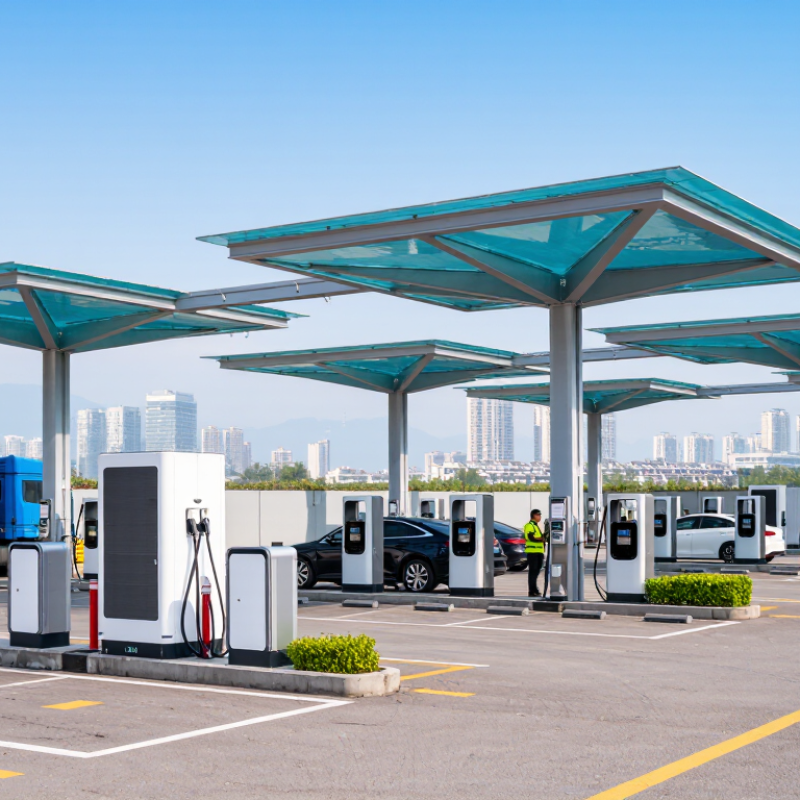
The 2026 Top China Ev Charging Manufacturers for Global Buyers guide examines the companies shaping a rapidly changing infrastructure market. China Ev Charging now covers residential wallboxes, commercial AC stations, high-power DC chargers, liquid-cooled systems, and fleet depots. A useful comparison must look beyond impressive output figures.
This review considers charging power, connector compatibility, OCPP support, payment integration, safety testing, warranty terms, and remote maintenance. It also examines factory capacity, export experience, software stability, and service coverage after installation. A 60 kW charger may suit an urban parking site, while a logistics depot may require 480 kW equipment and load management. Details matter.
Zhang Yongwei, vice chairman and secretary-general of China EV100, has emphasized, “Charging infrastructure is the foundation of the new energy vehicle industry.” That principle remains practical for global buyers. Hardware alone cannot create a dependable charging network. Local grid conditions, climate, installation skills, and spare-part access can decide real-world performance.
The market is not tidy. Some manufacturers publish strong laboratory results, yet provide limited field data. Others offer competitive prices but weaker technical support. These differences deserve careful attention. This guide therefore balances manufacturer claims with certifications, project records, buyer feedback, and transparent technical evidence. Regional regulations and connector preferences also change quickly, so rankings should not be treated as permanent. The strongest supplier is not always the largest one. It is the partner that can deliver safe equipment, reliable software, clear documentation, and responsive support across the charger’s working life.
China’s EV charging industry has become a critical part of the global electric mobility supply chain. The International Energy Agency reported more than 17 million electric cars were sold worldwide in 2024. China accounted for over 11 million sales, creating strong demand for home, workplace, highway, and fleet charging.
This scale supports mature manufacturing capabilities, but market size alone can mislead. The China Electric Vehicle Charging Infrastructure Promotion Alliance reported approximately 3.58 million public charging points by the end of 2024. Private chargers increased the national total far beyond that figure. China’s manufacturers now offer hardware for different climates, grid conditions, payment systems, and commercial use cases. Global buyers should examine field reliability, cybersecurity controls, connector compatibility, and after-sales response. A low purchase price may hide installation or maintenance costs.
Tips: Request independent test records, failure-rate data, warranty terms, and spare-parts plans. Check compliance with the destination market’s electrical and communication standards. Pilot a small batch before signing a large contract.
The IEA also notes that charging demand will grow sharply as electric fleets expand. High-power charging can reduce vehicle downtime, yet it may require expensive grid upgrades. This is where project experience matters. Some specifications look impressive on paper. Real sites can be less forgiving. Procurement teams should compare performance in heat, dust, rain, and unstable voltage conditions. They should also assess software openness, remote diagnostics, and local service capacity before selecting China-based suppliers.
Selecting a Chinese EV charging manufacturer requires more than comparing factory prices. The IEA’s Global EV Outlook 2024 reported that China held more than half of the world’s public charging points in 2023. This scale creates strong manufacturing experience, but it does not guarantee export readiness. Buyers should verify production records, independent test reports, and compliance with IEC 61851, IEC 62196, regional safety rules, and grid requirements.
Start with the charger’s real operating data. Request efficiency curves, output stability, thermal derating results, and protection records at high temperature. A 60 kW unit may not deliver 60 kW in a hot, enclosed parking area. Check IP and IK ratings, connector life cycles, emergency-stop response, and measured uptime from comparable sites. The Global EV Outlook also highlights the rapid growth of charging demand, making remote diagnostics and spare-parts availability commercial necessities, not optional features.
Software deserves equal attention. Confirm OCPP compatibility, API access, firmware control, user authentication, payment integration, and cybersecurity procedures. Ask how quickly faults are acknowledged and whether local technicians can replace power modules. The China Electric Vehicle Charging Infrastructure Promotion Alliance regularly publishes infrastructure statistics, but published volume is not the same as dependable service. A factory tour helps, though it can still show only a perfect day. Buyers should audit batch consistency, calibration methods, warranty exclusions, and total cost over five years. The cheapest quotation often becomes expensive after installation.
| Evaluation Dimension | Relevant Data Point | Recommended Benchmark for Global Projects | Why It Matters | Evidence Buyers Should Request |
|---|---|---|---|---|
| AC Charging Output | Common commercial AC configurations | 7.4 kW, 11 kW, or 22 kW; three-phase 22 kW requires suitable grid capacity and vehicle support | Determines charging time for homes, workplaces, hotels, fleets, and destination-charging sites. | Product datasheet, rated-current table, installation manual, and test report for the target electrical system. |
| DC Charging Output | Scalable fast-charging power classes | Typically 20–60 kW for urban sites, 60–180 kW for public fast charging, and 240 kW or more for high-power sites | Higher power can improve vehicle utilization, but it increases transformer, cabling, cooling, and site-cost requirements. | Continuous-output curve, derating curve, maximum input current, efficiency data, and thermal-management description. |
| Charging Connector Compatibility | Connector and vehicle-inlet standards | Support the target market’s required connector, such as IEC 62196 Type 2, CCS2, NACS, or GB/T 20234.2 | Connector mismatch can prevent use, restrict vehicle coverage, or require additional site hardware. | Connector certification, pinout documentation, supported vehicle list, and regional configuration options. |
| Communication Protocol | Charger-to-backend interoperability | OCPP 1.6J as a practical baseline; OCPP 2.0.1 preferred for new network deployments | Open protocols reduce dependence on a single software provider and simplify roaming, monitoring, and future upgrades. | OCPP compliance statement, version details, API documentation, interoperability test results, and live integration demonstration. |
| Vehicle Communication | Smart-charging and advanced vehicle-to-grid readiness | ISO 15118 capability where Plug & Charge, managed charging, or future bidirectional charging is required | Enables more advanced authentication, load management, and energy-management functions. | ISO 15118 feature list, supported message set, firmware roadmap, and compatibility test records. |
| Electrical Safety | Protection and residual-current monitoring | Overcurrent, overvoltage, surge, overtemperature, insulation, emergency-stop, and residual-current protection appropriate to the installation | Protects users, vehicles, and electrical infrastructure while supporting local approval and insurance requirements. | Single-line diagram, protection-component list, safety test reports, and local electrical-code compliance declaration. |
| Ingress Protection | Resistance to dust and water | At least IP54 for protected outdoor equipment; IP55 or IP65 is generally preferable for exposed sites, subject to design and certification | Outdoor chargers face rain, dust, condensation, cleaning, and temperature changes. | IP test certificate, enclosure design details, cable-entry specification, and installation limitations. |
| Mechanical Protection | Impact resistance for public equipment | IK08 or higher is a useful screening threshold for public-facing enclosures; site risk may require a higher rating | Helps reduce damage from accidental impact, vandalism, and vehicle movement. | IEC 62262 impact-test report, enclosure material specification, and bollard or collision-protection recommendations. |
| Operating Environment | Temperature, humidity, altitude, and installation conditions | Confirm the complete operating range, commonly around −30°C to +50°C for outdoor products, rather than relying only on a nominal rating | Performance may be reduced by high heat, freezing conditions, humidity, altitude, or inadequate ventilation. | Environmental test report, derating tables, humidity limits, altitude limits, and cold-start or heat-management procedures. |
| Energy Efficiency | AC-to-DC conversion and standby consumption | Request verified efficiency curves; target approximately 95% or higher at high-load operating points for modern DC systems | Higher efficiency lowers electricity losses, operating costs, and thermal-management demand. | Third-party efficiency test data at multiple load levels, standby-power figures, and power-factor data. |
| Grid Compatibility | Input voltage, frequency, phase, and power quality | Configuration must match the destination grid, such as 230 V single-phase, 400 V three-phase, or the applicable local standard | Incorrect input specifications can cause installation delays, poor performance, or equipment failure. | Input-range table, power-factor value, total harmonic distortion data, transformer requirements, and protection settings. |
| Cybersecurity | Network, identity, software, and update controls | Encrypted communications, role-based access, unique credentials, signed firmware, vulnerability handling, and secure remote updates | Connected chargers are networked assets and may process user, payment, and operational data. | Security architecture, penetration-test summary, vulnerability-disclosure process, update policy, and data-retention statement. |
| Payment and User Access | Authentication options for public charging | Support the project’s required combination of RFID, mobile application, QR access, contactless payment, or card-terminal integration | Convenient payment and access options directly affect utilization and customer satisfaction. | Supported payment methods, payment-service integrations, PCI-related responsibilities, transaction flow, and offline operation behavior. |
| Remote Operations | Monitoring, diagnostics, and load management | Real-time status, fault codes, remote restart, configurable power limits, tariff support, and scheduled charging | Remote visibility reduces service visits and helps operators control demand and operating costs. | Backend demonstration, alarm list, dashboard screenshots, reporting functions, load-balancing logic, and API documentation. |
| Certification and Market Access | Regional conformity requirements | Certification must match the destination market, such as CE for applicable European requirements, UKCA where applicable, or North American safety approvals where required | Certificates and declarations support customs clearance, site approval, insurance, and lawful commercial operation. | Current certificates, declarations of conformity, factory inspection records, certificate scope, and model-number traceability. |
| Quality Management | Production control and traceability | ISO 9001-certified quality management is a useful baseline; verify process control for the exact charger model | Formal quality systems help control component changes, testing, corrective actions, and batch consistency. | Quality certificate, incoming-inspection records, end-of-line test procedure, serial-number traceability, and change-control process. |
| Warranty and Service | Coverage, response time, and spare-parts support | Obtain written warranty terms, regional service contacts, defined response targets, and a spare-parts plan before purchase | Downtime can cost more than the initial equipment-price difference, especially for fleet and highway sites. | Warranty document, service-level agreement, escalation path, repair workflow, spare-parts stock location, and technician-training plan. |
| Supply-Chain Resilience | Lead time, component availability, and lifecycle support | Evaluate quoted lead time, minimum order quantity, production capacity, critical-component alternatives, and guaranteed software-support period | Stable supply and long-term support are essential for multi-site rollouts and replacement planning. | Capacity statement, delivery schedule, bill of critical components, end-of-life policy, and firmware-support commitment. |
| Total Cost of Ownership | Equipment, installation, energy, software, maintenance, and replacement cost | Compare a five- to ten-year lifecycle model rather than purchase price alone | Installation complexity, demand charges, software fees, maintenance, and downtime can materially change the project economics. | Itemized quotation, installation assumptions, subscription fees, energy-loss assumptions, maintenance schedule, and replacement-part pricing. |

International buyers evaluating China EV charging manufacturers need more than a low factory quotation. They need evidence that equipment will perform in their climate, network, and payment environment. Manufacturers with export experience should provide test reports, product drawings, installation guides, and clear warranty terms. Ask whether the charger supports common communication protocols, remote monitoring, load management, and local electrical requirements.
A factory audit can reveal useful details. Check assembly areas, cable storage, quality records, and final inspection procedures. Request samples before placing a large order. Test charging speed, connector temperature, screen visibility, emergency stopping, and software stability. Small details matter. A charger installed beside a dusty highway faces different demands from one used in an indoor parking facility.
International buyers should also review packaging, spare parts, training, and technical response times. Some suppliers promise fast support but provide vague service arrangements. That weakness can become expensive after installation. Product compliance must be verified for the destination market, not assumed from general certificates. A professional supplier should explain limitations honestly. No factory is perfect. Even strong manufacturers may have delays during component shortages or software updates. A careful purchasing process leaves room for those realities and documents every agreed specification.
Public charging piles in China increased steadily, highlighting the scale of the domestic market supporting EV charging equipment manufacturers and international buyers.
Data: China EV Charging Infrastructure Promotion Alliance annual industry statistics. Figures are rounded estimates of public charging piles installed nationwide.
For global buyers, China’s 2026 charging market offers more than high power ratings. It combines AC wallboxes, commercial DC chargers, charging cabinets, and depot systems. A practical portfolio may include 7–22 kW AC units for homes and hotels. It may also include 30–60 kW DC chargers for urban parking. Highway sites often require 120–480 kW equipment, liquid-cooled cables, and dynamic power sharing.
Standards need closer attention than appearance. Buyers should verify GB/T compatibility for China-focused vehicles, plus CCS2 or other regional connectors for export markets. IEC 61851 supports charging control, while ISO 15118 can enable secure communication and plug-and-charge functions. OCPP 1.6J and OCPP 2.0.1 help connect chargers with different management platforms. This sounds simple. It is not always simple.
Site testing should measure cable temperature, voltage stability, charging noise, and network recovery after disconnection. Look for IP-rated enclosures, residual-current protection, emergency stops, and documented firmware procedures. A useful product portfolio also includes load balancing, payment integration, remote diagnostics, and spare power modules. Some suppliers still present impressive laboratory data without enough evidence from heat, dust, or winter conditions. That gap deserves scrutiny. Buyers should request test records, local certification, warranty terms, and service response times before approving a large order.
Global EV charging demand is moving from pilot projects to infrastructure procurement. The IEA Global EV Outlook 2025 reports that global electric car sales exceeded 17 million in 2024. China represented more than 11 million sales. The IEA Global EV Outlook 2024 also recorded over four million public chargers worldwide in 2023, rising about 40% annually. This growth increases the cost of poor export preparation. Buyers should request model-specific test reports, factory quality records, and shipment references. Not brochures.
Compliance must remain country-specific. AC and DC equipment commonly requires evidence against IEC 61851 and IEC 62196. Software interoperability should be tested through OCPP 1.6 or 2.0.1. In Europe, CE obligations may involve LVD, EMC, and RoHS requirements. CE marking is not universal approval. For North America, NRTL certification may be necessary. Ask for declarations, accredited laboratory reports, risk assessments, and traceable serial numbers.
Export-ready suppliers should show spare-part lead times, remote diagnostics, firmware control, cybersecurity procedures, warranty exclusions, and local service training. ISO 15118 support can improve smart charging and plug-and-charge functions, but advertised compatibility needs field validation. I would inspect sample units, repeat insulation and thermal tests, and audit change-control records. This takes longer than comparing prices. It may reveal uncomfortable gaps. Supplier scoring should value compliance, uptime evidence, and after-sales capacity more than factory size.